
Today’s article is about why McDonald’s buys land instead of just selling burgers.
The McDonald’s real estate strategy is one of the most fascinating business stories in the world.
Instead of just selling burgers and fries, the company often buys or controls the land where its restaurants operate. The franchise owners then pay McDonald’s rent for the location. This strategy creates a steady income stream that continues regardless of how much food the restaurant sells.

This system allows them to generate revenue not only from food sales but also from rent, franchise fees, and property management. Many business experts say McDonald’s is actually a real estate company disguised as a restaurant chain.
Today, about 93 percent of McDonald’s restaurants are operated by franchisees, meaning the company collects rent and royalties from thousands of locations worldwide.
The Ray Kroc Real Estate Strategy
1940 – McDonald’s Is Founded
Dick and Mac McDonald opened McDonald’s Bar-B-Q restaurant on Fourteenth and E streets in San Bernardino, California. It is a typical drive-in featuring a large menu and car hop service.
The real estate strategy dates back to Ray Kroc, the businessman who expanded the brand in the 1950s.
Ray Kroc understood something many restaurant owners missed. The true long-term value was not just the food sold but also the land beneath the restaurant.
His approach was simple but powerful:
• Find high-traffic locations
• Purchase or control the property
• Lease the restaurant location to franchise owners
This approach allowed the company to grow rapidly while also building a valuable real estate portfolio.
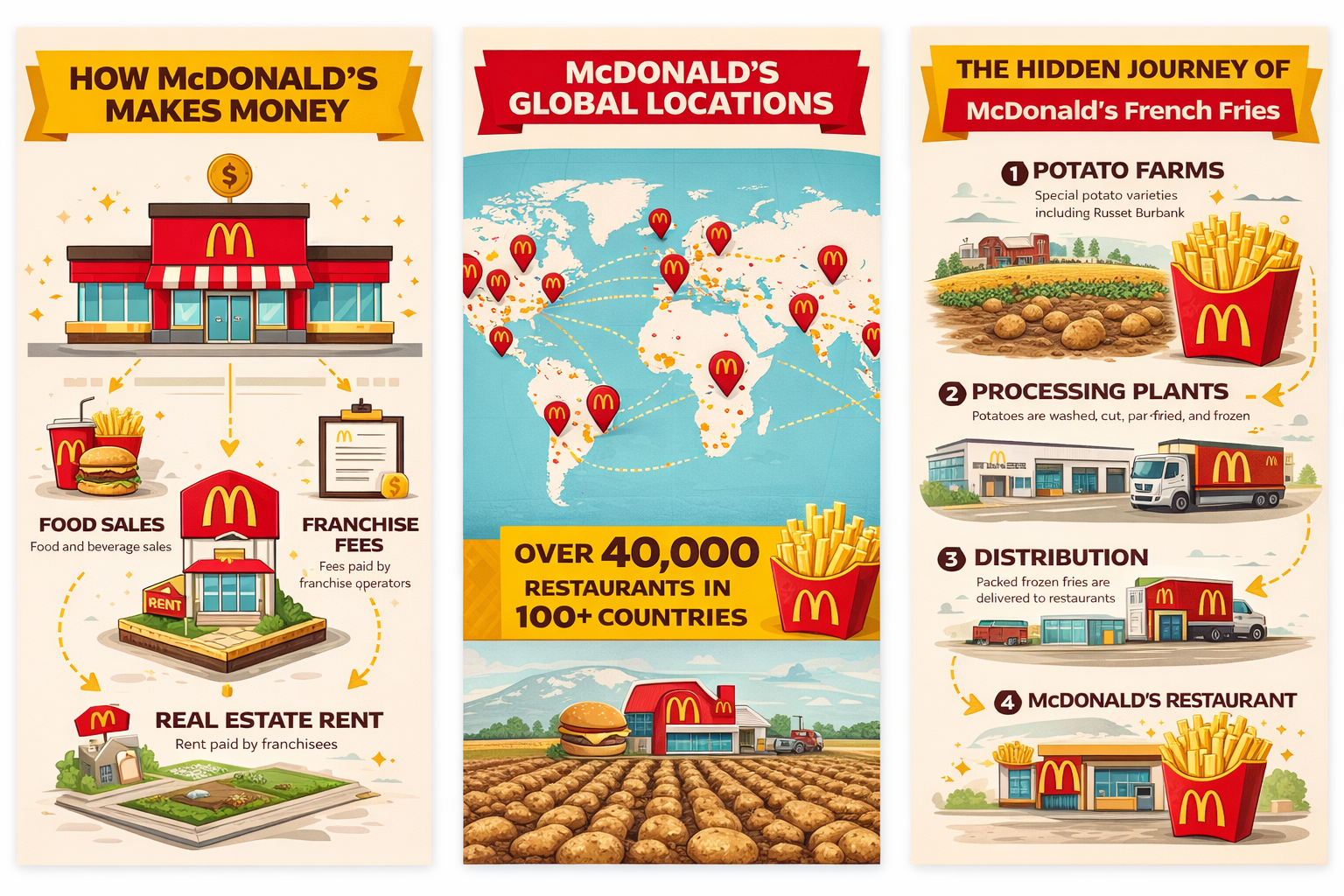
How McDonald’s Makes Money
While burgers and fries are the most visible part of the business, the revenue comes from several sources.
Major revenue streams include:
• Franchise fees paid by restaurant operators
• Rent paid by franchisees for the property
• Food and beverage sales
• Brand licensing and partnerships
Today, about 93 percent ofMcDonald’s restaurants are operated by franchisees, meaning the company collects rent and royalties from thousands of locations worldwide.
Why Location Matters So Much
Fast food success depends heavily on location. The company carefully studies potential locations before building a restaurant.
What are the factors they often analyze? Traffic patterns, population density, nearby schools and offices, commuting routes, and visibility from major roads.
Because of this detailed planning, many of the restaurants sit on some of the most valuable commercial corners in cities and towns.
A Global Network of Restaurants
McDonald’s operates more than 40,000 restaurants worldwide and serves millions of customers each day.
Many of these restaurants are located in prime commercial areas in major cities. Cities like London, Tokyo, Paris, Dubai, and New York.
These locations help maintain steady customer traffic while also increasing the value of the land itself.
The Strategy of Building for the Future
Another interesting aspect of the company’s real estate strategy is that the company sometimes builds restaurants in developing areas before they become busy commercial zones.
While these locations may not immediately generate large profits, they position the company to benefit as neighborhoods grow and traffic increases. In this way, they often act like a long-term real estate investor, thinking years ahead when choosing locations.
How McDonald’s Influenced Other Chains
Many other restaurant chains have adopted similar strategies after seeing the success of McDonald’s. You know these companies, such as Burger King, Wendy’s, Starbucks, and more. They have also focused heavily on prime real estate locations, though McDonald’s remains one of the most successful examples of this model.
A Business Lesson Hidden in Plain Sight
The McDonald’s story offers an important lesson in business and real estate. Sometimes the greatest value in a company is not the product being sold but the assets supporting the business.
Focusing on land ownership and location strategy, McDonald’s built one of the most recognizable brands in the world while also creating a powerful real estate portfolio.
In Conclusion Today
The story of McDonald’s goes far beyond burgers and fries. Behind the golden arches are strategies involving technology, real estate, global supply chains, and the millions of workers who keep the restaurants running every day.
In articles, we will explore more surprising facts about McDonald’s and the fast-food industry, including the technology behind modern kitchens, the global supply networks that support fast food, and the evolving role of employees in an increasingly automated world.